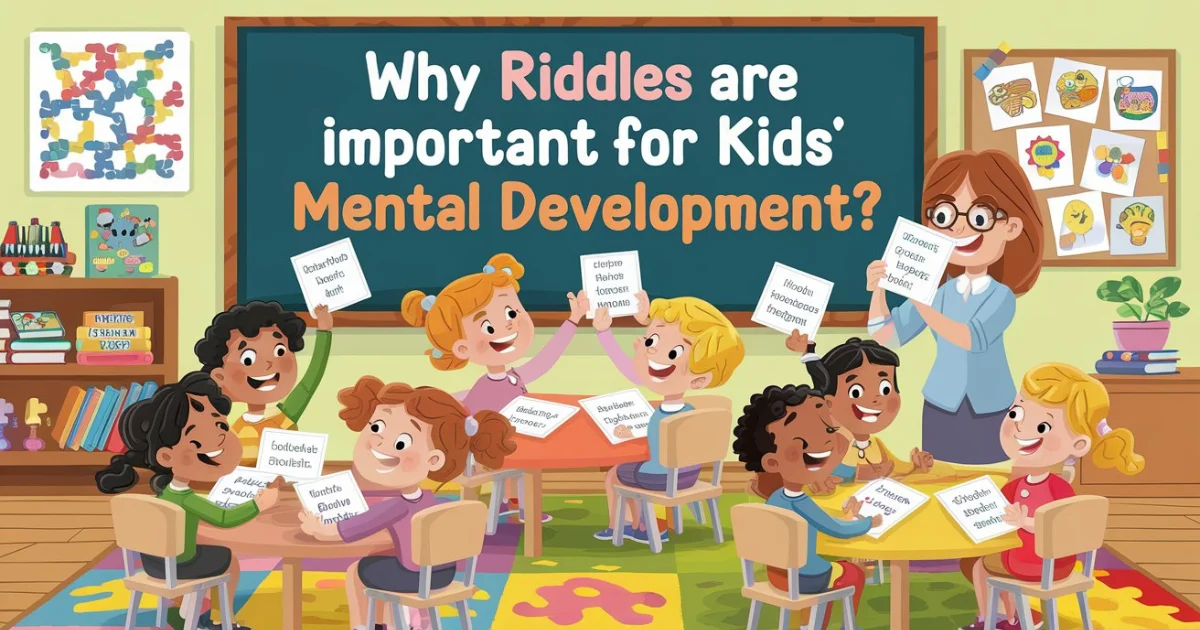
As parents, educators, and developmental psychologists, we constantly seek ways to foster children’s brain development, linguistic capacity, and analytical skills. While digital games, educational apps, and interactive toys are highly marketed, one of the most effective, time-tested cognitive accelerators is completely free: the riddle.
Posing riddles, puzzles, and verbal teasers to children builds neural pathways, strengthens logical reasoning, and encourages cognitive resilience. According to the authoritative studies by the Harvard University Center on the Developing Child, active mental problem solving during early stages of development builds critical executive function and self-regulation.
We can also look at resources on HealthyChildren.org by the American Academy of Pediatrics for insights on interactive play.
If you’re looking for a structured solving guide, read our walkthrough on how to solve riddles, or discover their origins in our article about the history of riddles. In this comprehensive article, we will examine the neuroscience behind children’s brain development and highlight the developmental advantages of solving riddles daily.
The Neuroscience of Childhood Brain Development
A child’s brain is a hotbed of neural activity. During early childhood, the brain undergoes rapid “synaptogenesis”—the creation of billions of synapses (connections between neurons).
As children grow, their brains refine these networks through a process called “synaptic pruning,” where active pathways are strengthened, and unused connections are discarded. This pruning is highly dependent on environmental stimulation and cognitive exercises.
Solving riddles exercises multiple areas of the brain simultaneously. It engages the temporal lobe for language comprehension, the prefrontal cortex for logical planning and decision-making, and the parietal lobe for spatial and structural reasoning.
By demanding lateral thinking (connecting seemingly unrelated concepts), riddles build rich neural density, enhancing “neuroplasticity”—the brain’s ability to reorganize itself by forming new connections throughout life. You can learn more about structured developmental milestones on our Kids Riddles Hub Page.
6 Core Cognitive Benefits of Riddles for Kids
Integrating riddles into children’s daily routines provides six primary cognitive and emotional advantages.
1. Vocabulary Expansion and Phonological Awareness
Riddles play with the sounds, structures, and spelling of words. Puns, double meanings, and homophones require children to think about language as an object of play.
When a child learns a riddle about a “ruler” (a measuring tool vs. a king), they are introduced to polysemy (multiple meanings of a single word).
This exposure builds phonological awareness, expands vocabulary, and helps children understand metaphors—skills crucial for advanced reading comprehension and writing. Explore our “What Am I” Riddles Collection for excellent vocabulary-building exercises.
2. Enhancing Reading Comprehension and Contextual Analysis
Standard reading exercises often ask children to retrieve facts directly from a text. Riddles, however, require children to analyze text deeply, read between the lines, and search for context clues.
To solve a riddle, a child must evaluate every adjective and verb, looking for hidden cues. This teaches them to become active readers who analyze structure, tone, and subtext rather than passive decoders of text.
Try some of these analytical exercises with our Animal Riddles Hub.
3. Building Logical Deduction and Mathematical Thinking
Many riddles are logic grid puzzles in disguise. They present a set of rules (e.
g., “Mary is older than John, but younger than Sue…”
) and require the child to deduce the correct relationships. This type of reasoning maps directly to algebraic thinking, coding, and the scientific method.
Children learn to group variables, test hypotheses, and draw valid conclusions based on available data, setting a strong foundation for STEM subjects. Practice these skills on our dedicated Math Riddles Hub.
4. Fostering Lateral Thinking and Cognitive Flexibility
In standard school curriculums, children are taught linear problem solving: step A leads to step B, which leads to the single correct answer. While useful, this approach doesn’t prepare kids for real-world problems that require creative innovation.
Riddles demand lateral thinking—forcing children to break free from traditional linear patterns and connect concepts across different categories. This builds cognitive flexibility, allowing children to adjust their strategies when faced with unexpected obstacles.
For advanced puzzles, visit our Brain Teasers Library.
5. Cultivating Intellectual Resilience and Frustration Tolerance
Riddles are not solved instantly. They require thought, trial, error, and patience.
In an era of instant gratification (triggered by short-form video content and fast digital rewards), riddles are an excellent tool to build attention span and frustration tolerance. When a child struggles to solve a riddle, gets it wrong several times, but refuses to give up, they build “grit” and intellectual resilience.
The final “Aha!” moment of discovery triggers a dopamine release, reinforcing that effort leads to reward.
Try this out with our tricky hard riddles list.
6. Strengthening Social Bonding and Cooperative Learning
Riddles are inherently social. Sharing riddles with friends, parents, or teachers creates cooperative learning opportunities.
Puzzling over a riddle together teaches kids to listen to others’ perspectives, explain their own logic, and collaborate to find solutions. It turns learning into a shared game, building communication skills and boosting self-esteem.
You can use our seasonal Holiday Puzzles Guide for festive family activities.
Age-Appropriate Riddle Guide
To maximize the cognitive benefits, it is crucial to match riddles with your child’s developmental stage. Posing puzzles that are too hard can lead to frustration, while puzzles that are too easy fail to stimulate neural growth.
| Age Group | Focus Area | Example Pattern |
|---|---|---|
| Ages 4–6 | Metaphors & Metamorphosis | “I hatch from an egg, crawl on leaf, sleep in a cocoon, and fly away as a butterfly. What am I?” |
| Ages 7–9 | Linguistic Puns & Homophones | “What has hands but cannot clap?” (A clock) |
| Ages 10–12 | Logical Deduction & Sequences | “The person who makes it doesn’t want it, the buyer doesn’t use it, and the user doesn’t know it. What is it?” (A coffin) |
Practical Strategies for Parents and Educators
Here are three simple ways to incorporate riddles into children’s learning environments:
- The Dinner Table Riddle: Keep a deck of riddle cards or open a riddle page during dinner. Make it a family challenge where everyone gets to pitch answers and explain their logic.
- Classroom Warm-Ups: Teachers can write a “Riddle of the Day” on the board. Students can collaborate in groups during the first five minutes of class to solve it, priming their brains for active learning.
- Reward Accomplishments: Encourage kids to use resources like our online leaderboard, earning badges and building streaks, gamifying their intellectual development.
Frequently Asked Questions (FAQ)
Q: Can riddles help children with learning differences like ADHD or Dyslexia?
A: Yes!
The interactive, gamified nature of riddles can engage children with ADHD who struggle with traditional reading materials. For children with Dyslexia, short wordplay riddles make spelling patterns and phonological boundaries fun and less stressful.
Q: How many riddles should a child solve daily?
A: Just one high-quality riddle a day is enough to stimulate cognitive growth and establish a fun routine without causing mental fatigue.
To start your child’s brain training journey, explore our dedicated Kids Riddles Category Hub, or explore standard blog categories like Kids Riddles Posts and Animal Riddles Articles. Or challenge them with our general easy riddles collection and timeless classic riddles library to build their confidence today!